Answers to your questions about writing-to-read Heart Words
-
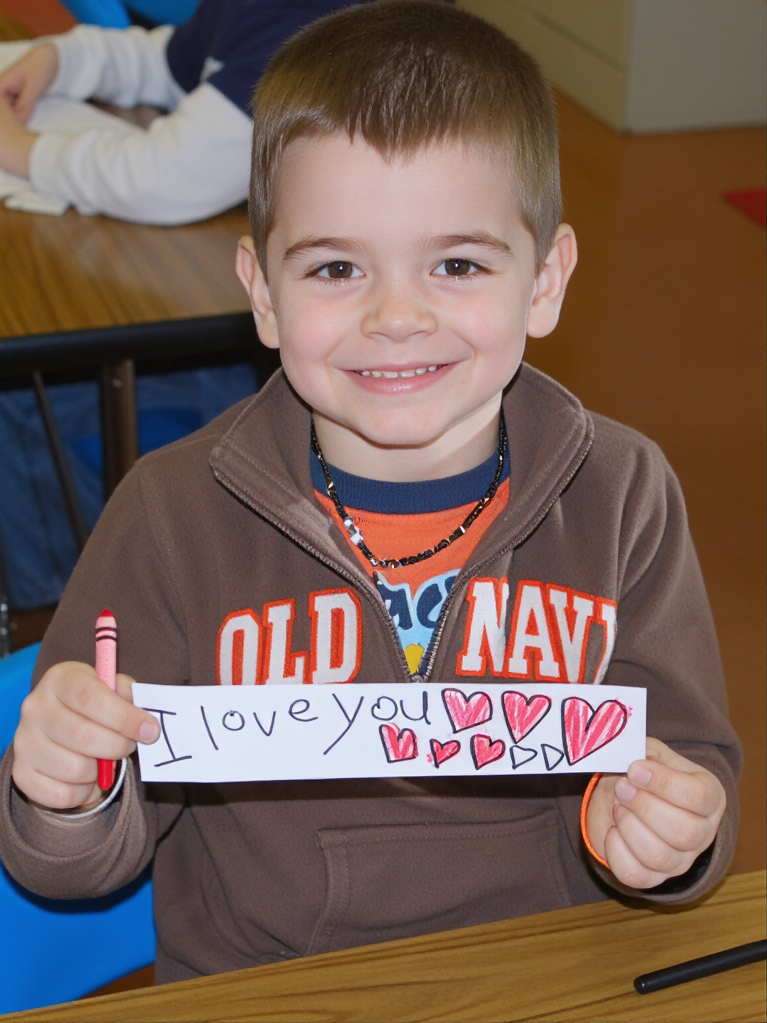
We call them Heart Words because we want children to know these words instantly—by heart! These are the words that help children write meaningful, heart-connected sentences like “I love you.” or “I love my dad.”
-
Children learn best when:
· They have a crystal-clear, achievable goal
· Their progress is monitored
· Their success is recognized
· Teaching is enthusiastic and engaging
· Expectations are high
(For more on this, see Visible Learning for Teachers by John Hattie.)
We also know:
· Writing instruction helps children become better readers.
· To build stamina in Writing Workshop, children need a group (repertoire) of words and sentences they can write fluently “by heart.”
· They also need phonics skills so they can write simple CVC words and confidently attempt unknown words.
Most importantly, research shows that emotional engagement drives learning. When children feel joy, love, and excitement, the learning sticks and moves into long-term memory. It’s how the brain works best!
-
No. Most teachers have children keep the sets at home in a growing Heart Word collection box.
Here’s how it typically works:
Each set is given as a special literacy gift.
When a child masters one set, the teacher gives them the next set on a ring.
In some classrooms, children bring their ring back to school, add the new words, and keep building their collection.
After mastering the first four sets, children may receive a larger ring to hold additional (first-grade) words.
-
No. Words are given gradually.
Here’s the step-by-step process:
1. Early in the year (September), children take home their first pink set after most words have been introduced in class.
2. Children practice these words nightly at home.
3. Once they demonstrate mastery, they receive the next set.
4. This continues one set at a time.
Children always know:
What they are currently working on
What their goal is
Some children may master all four sets quickly, while others may still be working on the first set. This is how learning is naturally differentiated.
-
The process looks like this:
1. Introduce the word using multisensory strategies (Sing, Sign, Spell, Read!).
2. Practice writing the word repeatedly.
3. Add the word to the word wall while students watch.
4. Often, the class sings the spelling song again.
5. Review previously learned words on the wall.
It’s important that children know exactly where to find and use these words.
-
The colors are a personal choice, but they are used consistently and intentionally:
Pink and purple represent Heart words
Yellow signals: “Wait—keep working, you’re almost there!”
Green means: “Go! You’ve mastered all 62 words!”
You can choose any colors that work for you, as long as they are consistent across your word sets and word wall.
-
These words come from real classroom writing—not just traditional lists.
We chose words that:
Kindergarten students actually use in their writing
Help them build meaningful sentences
For example, “I love you” is introduced early because it’s powerful and meaningful. These words also serve as anchor sentences for handwriting practice.
-
Every teacher may do this a little differently, but here are common approaches:
Children read words from a wall chart or floor chart
They demonstrate that they can also write the words correctly
Assessment can happen during:
Morning arrival time
Literacy choice time
Recess (brief one-on-one check-ins)
In some classrooms:
Children share their new skills with the class
They receive a class cheer
With pink and purple sets, it’s important that children can write the words—not just recognize them.
-
First, make sure the child can:
Instantly write all the words
Use good handwriting
Then:
Work with the K–2 team to introduce first-grade words
Some teachers also:
Let children create their own themed word sets (like “Princess Words” or “Elephant and Piggie Words”)
Use writing-to-read Heart Words from Writing Workshop notebooks
This keeps advanced learners challenged and engaged.
-
To make this successful:
Kindergarten teachers collaborate with the K–2 team: They may continue teaching Heart Words.
Some classrooms add additional colors (like blue, peach, or red), and many students learn 100+ words by the end of kindergarten.
This approach:
Keeps learning visible
Differentiates instruction
Celebrates mastery
-
Only one word is introduced at a time.
Here’s the process:
1. Introduce a single word
2. Use Sing, Sign, Spell, and Read
3. Practice writing it in different ways (often on whiteboards)
4. Use it in sentences
Typically:
1–2 new words are introduced each week
Previously learned words are reviewed regularly
-
Most reading program word lists are already included.
If needed:
Add missing words to your green set
Or create a new set (for example, blue words)
Because this is a writing-to-read approach:
Encourage children early on to write meaningful sentences
This strengthens both writing and reading skills
-
No, never all at once.
Here’s how it works:
1. Words are introduced one at a time
2. They are practiced in handwriting and word work
3. Students build fluency with one sentence before moving to another
For example:
First: “I love you.”
Then later: “I love my cat.”
Differentiation happens naturally:
Children only receive the next set after mastering the previous one
Some children move faster with home practice
Others use the word wall for support
All children are expected to spell taught words correctly.
-
Start by watching the free Masterclass Seminar #3 Writing-to-read Heart Words. Visit Resources page for direct link.
Answers to your questions about handwriting
-
We want children reading and writing lowercase letters right from day one. Starting with lowercase builds a classroom of prolific, engaged young writers who meet rigorous standards by year’s end. Beginning with capitals — as some commercial programs do — delays that progress.
-
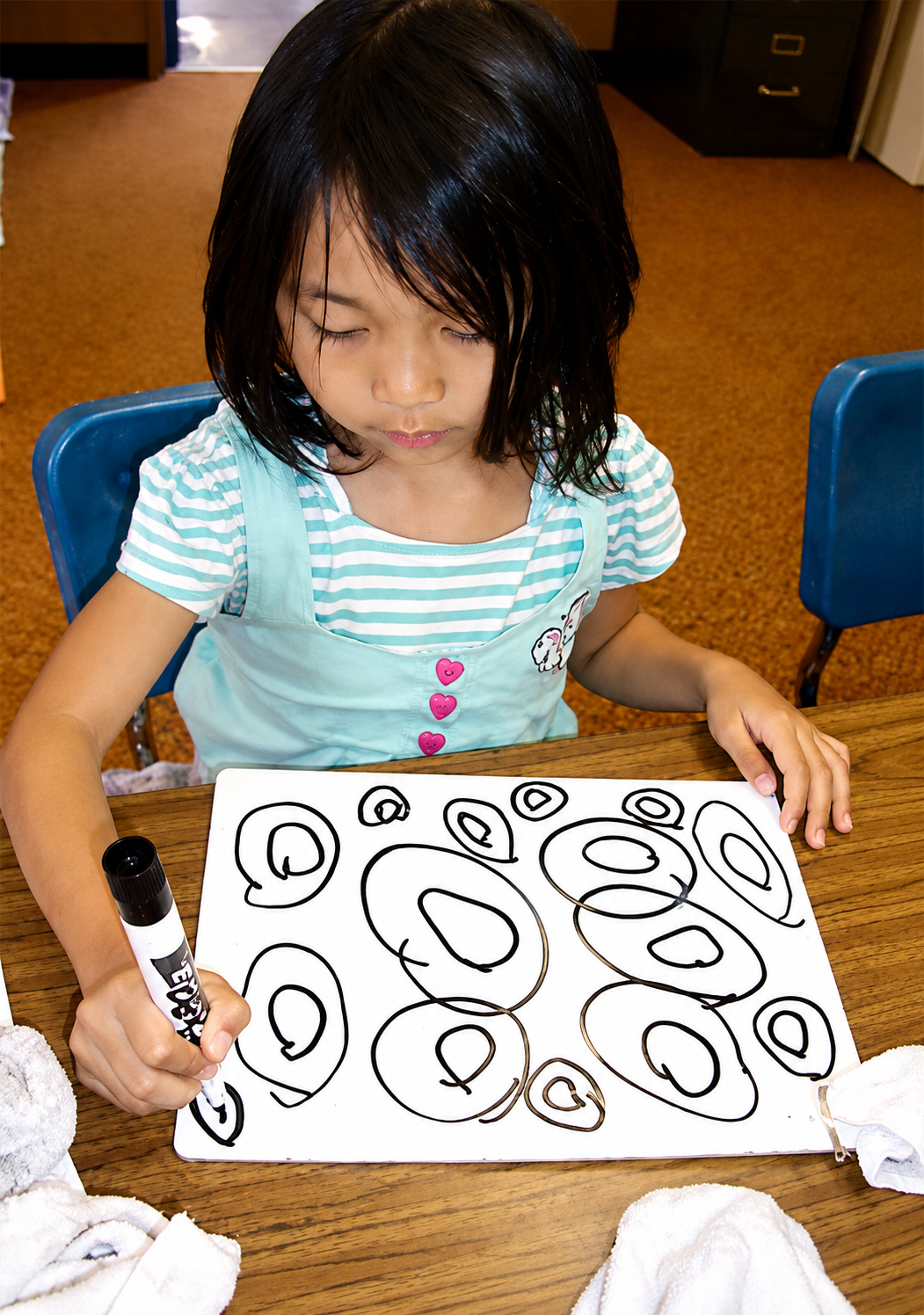
Until children have automatic control over basic letter shapes, lines can create unnecessary frustration. The brain doesn’t learn well under cognitive overload. Once letter forms are fluent, teachers can switch to three-lined paper for the Name Ticket model and practice.
-
K–1 teams should decide on a consistent progression together. A common sequence: unlined paper early in the year → "kid writing" paper with a white space and optional shaded underwriting area → single-lined paper by mid-year → traditional three-lined paper by May for children who are ready.
-
Right from the start, using the power sentence “I love you.” Children verbalize as they write: “I (space), love (space), you (period).” With frequent modeling, they quickly learn that spaces help everyone read their sentences.
-
Kindergarten-friendly handwriting is integrated with phonics and writing-to-read word work — not taught as isolated drill. Key differences:
· Multisensory: includes fingerspelling, music, movement, and the arts
· No consumable workbooks to repurchase each year
· Strong “Parents as Partners” component
· Letters are taught within the context of real words from the start
· Proven successful with Common Core accelerated writing standards
· No occupational therapist required (though we’d love one in every school!)
-
The vertical manuscript alphabet is more quickly mastered by young children, and it’s visually consistent with the alphabet they use to learn to read. (We do borrow D’Nealian’s efficient continuous motion for forming o, a, c, d, and g.)
-
In summary:
· Teach lowercase letters first, beginning with the child’s name
· Weave capital letters into authentic writing experiences
· Use multisensory memory hooks to accelerate development
· Teach o, a, c, d, and g as continuous motion letters
· Teach for immediate transfer to writing workshop
· Avoid one-size-fits-all, isolated skills approaches
· Don’t waste limited budgets on consumable materials
-
I haven’t personally used commercial programs, but colleagues report that they can be expensive, slow-moving, and that practicing isolated letters on worksheets doesn’t transfer well to actual writing. That said: if a program works for you, use it! Consider weaving fingerspelling and Heart Word handwriting practice into whatever framework you’re using.
-
No. We do not recommend using iPads for teaching handwriting.
-
Teach them separately, using different language and movement from the start:
· “d” first: "Curve up and around, way up and down." Practice with words like “dog” and “dad.”
· “b” later: "Down, up and around." Practice with “book,” “by,” and “bat.”
When children verbalize different directional cues for each letter, the brain cues them differently. Introducing both letters with the same initial downward movement is what causes the confusion.
-
Left-handed children face unique challenges worth acknowledging. For large muscle patterning, the left-handed child grasps both hands together to perform the movements. Search online for “Support for left-handed writers” for helpful resources and strategies.
-
Music, sign language, movement, and dance create a multisensory, memorable link between high-frequency words, phonics, and handwriting — multiplying your teaching effectiveness. The “O” Dance and handwriting songs and chants for 32 Heart Words are available as free downloads under our Resources tab.
-
Fingerspelling is the best multisensory tool we know of for developing both finger muscles and ABC/phonics memory connections in young children. It’s wonderful to see more preschool and Head Start teachers using it. Instructional videos are available on our YouTube channel.
-
Our publisher, Sign2Me, has provided quality instructional YouTube videos, including an excellent fingerspelling tutorial. Watch it with your students and learn right alongside them!
-
The Kindergarten-Friendly Handwriting, Phonics, and Word Work books reinforce patterns already introduced through Essential Handwriting Lessons. Most teachers begin them once students have internalized basic handwriting motions — some start in November, others wait until January, depending on class progress. These pages also support differentiated instruction for children who need additional support.
-
Directional arrows are usually handwritten — the first arrow is in red. Download our free Kindergarten Handwriting resource for more details.
-
Start with the free Masterclass Seminar #1: Multisensory ABC and Phonics Immersion. You’ll learn to fingerspell right along with your early learners, using the fingerspelling videos in the Masterclass. For more depth, download the free Masterclass Guide that goes with the seminar. Watch Seminar #1:
-
Yes. The companion Teacher’s Guide is a free download that comes with the Masterclass. For more ideas and best practices, join our newsletter.
-
Send home the free Play Dough Mats: ABC and Fingerspelling download. It includes the Family ABC Phonics Reference Chart, with the key phonics symbols and a fingerspelling guide. Make as many copies as you need — families love it! Find it on the Resources page.
-
Make copies of the free Play Dough Mats: ABC and Fingerspelling download. It includes the key phonics symbols and a fingerspelling guide. Families love it!
-
Teachers tell us they love it because it’s meaningful, authentic, and multisensory. It supports English language learners and builds life skills. And it taps into the musical brain: when children sing, say, and do, they remember far more.
This isn’t a cute, short-term strategy. It’s a rich language arts experience that also teaches American Sign Language, builds vocabulary, and grows confident performers. There are no consumable workbooks, and most of the teacher support is free online. Joyful learning for a lifetime!
-
Yes — it’s perfect for both! Teachers, parents, and young children love this musical, multisensory way to learn the alphabet and phonics. For many children, it’s simply their favorite ABC book.
Our local Head Start teachers saw a big jump in letter knowledge among children who sang and fingerspelled with their families the summer before kindergarten.
-
Absolutely. Multisensory teaching speeds up learning, and fingerspelling works alongside any phonics program. As your team watches the free Masterclass, you may find you’re ready for a more kindergarten-friendly approach to ABC phonics down the road.
-
Dr. Marilyn Daniels studied this directly. See her book Dancing with Words: Signing for Hearing Children’s Literacy.
We also draw on decades of neuroscience research on multisensory teaching and learning. Here are some of our favorite resources on building the reading brain:
• Building the Reading Brain by Pat Wolfe and Pam Nevills
• Mind, Brain, and Education: Neuroscience Implications for the Classroom edited by David Sousa
• Mindset: The New Psychology of Success by Carol Dweck
• Visible Learning for Teachers: Maximizing Impact on Learning by John Hattie
John Hattie’s synthesis of 15 years of education research shows that engaging, visible teaching raises achievement — and that’s exactly what ABC phonics immersion looks like. Language acquisition and early literacy research agree: the more actively children take part in real-world learning, the more they gain.
-
It’s consistent with best research practices and worthy of children’s time and involvement. It has worked in countless preschool and kindergarten classrooms and homes. Teaching is personal and meaningful, multisensory and rich in the arts, and it builds strong family literacy connections.